
If you work anywhere near UK innovation policy, you'll know the Catapults. If you don't, they're one of the more quietly significant pieces of national infrastructure the UK has built over the past fifteen years, and they represent a fascinating model for how a country tries to turn research strength into industrial and economic advantage.
We work with several of them. So this feels like a good moment to explain what they are, why we think they're an innovative model in their own right, and what our role is in helping them run their programmes.
What are "Catapults"?
The Catapult Network is a group of nine not-for-profit technology and innovation centres, established by Innovate UK (part of UK Research and Innovation) between 2011 and 2018. Each one specialises in a particular sector, theme, or technology: Connected Places, Digital, Energy Systems, Satellite Applications, Compound Semiconductors, High Value Manufacturing, Cell and Gene Therapy, Medicines Discovery, and Offshore Renewable Energy.
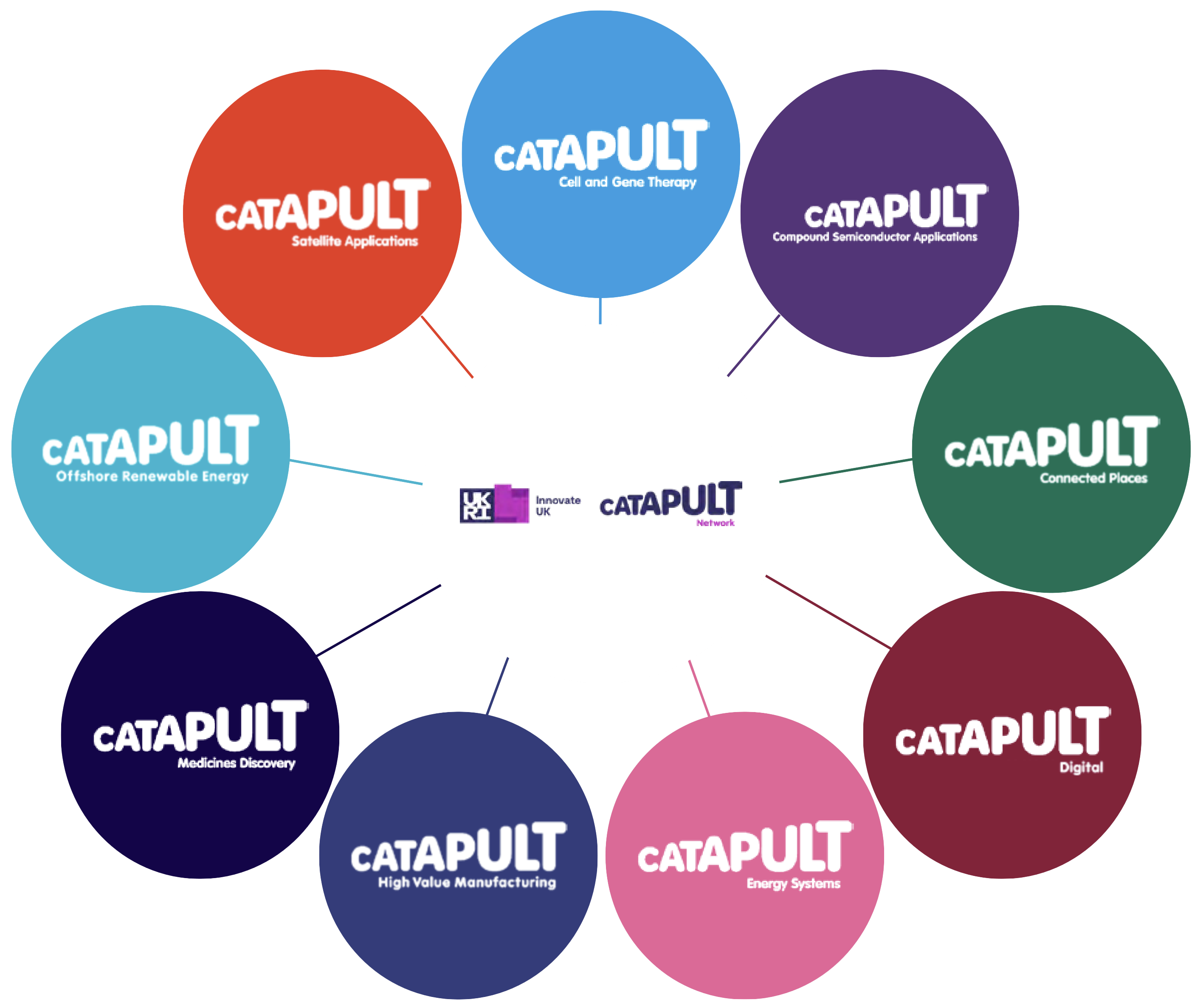
Their purpose is to bridge the gap between research and commercialisation; the point where good ideas emerging from universities and R&D too often stall before reaching the market. Catapults provide a combination of world-leading facilities, technical expertise, and equipment that individual businesses, particularly smaller ones, couldn't access on their own. They remove barriers to commercialisation, connect supply chains, and help businesses grow and scale in the UK and internationally.
The funding model is distinctive and worth understanding. Catapults operate on a "thirds model": roughly one third of funding comes from core government grants via Innovate UK, one third from commercial and industry contracts, and one third from collaborative R&D funding won competitively as part of consortia. This structure is deliberate, it's designed to keep the Catapults independent of any single part of the innovation ecosystem, and to ensure they remain fully responsive to industry rather than purely grant-driven. In the 2022 Autumn Statement, the government announced a 35% increase in Catapult funding compared to the previous cycle, representing a £1.6 billion investment that signalled the centrality of these institutions to national innovation strategy.
Why is the model innovative?
It would be easy to think of the Catapults as simply well-funded research centres, but the way they operate reflects forward-thinking approaches to how innovation gets fostered at national scale.
They embody the "triple helix" model in practice, which is the idea that meaningful innovation happens at the intersection of government, academia, and industry, rather than within any one of them. Catapults are explicitly designed as the connective tissue between these three worlds, creating the collaborations that none of the parties could easily build alone.
They run tiered and multi-year programmes that allow players of very different sizes to participate. A well-designed Catapult programme can bring an early-stage startup into the same innovation ecosystem as an established multinational, with entry points calibrated to different levels of maturity. This levelling of the playing field is one of the more valuable things the model does and it means the best ideas can come from anywhere, not just from the organisations with the deepest R&D budgets.
They power innovation clusters and networks, including building the industrial ecosystems, supply chain connections, and communities of practice that sustain innovation beyond any single project. This networked approach to industrial innovation is exactly the kind of cluster-building that runs through so much of current UK innovation policy, including the Local Innovation Partnerships Fund.
The Catapults occupy a much-needed role in shaping policy by providing dedicated spaces where government, academic, and private sector stakeholders can be heard, and where the direction of sector-level innovation can be discussed and influenced. That policy-shaping function, informed by deep sector expertise, is something few other institutions are positioned to provide.
How do we work with Catapults?
SimplyDo currently works with Connected Places Catapult, Digital Catapult, and Energy Systems Catapult: three centres operating at the forefront of, respectively, cities and transport, advanced digital technologies, and the energy transition.
Our role is to provide the platform on which they run their innovation programmes. That covers a lot of ground.
We enable flexible innovation programmes, including open calls and opportunities of many different shapes, including gated and phased structures that take applicants through multiple stages. Automatic sifting and labelling according to defined rules helps manage volume without manual overhead. Multi-round assessment and judging supports the kind of rigorous, staged evaluation these programmes require.
We support benefit and impact capture, allowing programmes to record expected ROI at the outset and track realised impact as it materialises, which matters enormously for institutions that need to demonstrate value to Innovate UK, government, and their industry partners.
We provide comprehensive reporting through in-platform reports, downloadable exports, Power BI connections, and data warehouse integrations, so that programme data can be surfaced, analysed, and combined with whatever else an organisation needs to see alongside it. This includes reporting and insights from previously-run programmes, such as end-of-phase reporting that informs how the next phase is designed.
More recently, we help power innovation clusters and networks, fostering the individual, government, academic, and business networks that sit at the heart of the Catapult model, across a wide range of industries.
The common thread is that we provide a platform that lets the Catapults we work with run their innovation programmes at scale, without the operational stress that so often accompanies programmes of this complexity, giving them confidence in their ability to scale up their own operations.
Why do Catapults choose SimplyDo?
Institutions like these don't select platforms lightly, and we feel privileged that they choose to work with us.
Support is central. We pride ourselves on leading-class customer support, forming an extension of the innovation teams we work with where that's needed. Not just supplying software and disappearing, but working alongside our customers as a real partner in delivery.
Our security and data posture meets the bar these organisations require. That means enterprise-ready security, sovereign data held on UK infrastructure, and a full set of security features including password and MFA policies, and SSO via both OAuth2 and custom SAML2 connections. It's backed by accreditations including ISO 27001 and Cyber Essentials Plus, and supported by the integrations these organisations need to fit SimplyDo into their wider technical environment.
Underpinning all of it is a team that is highly responsive and flexible, able to meet the operational and technological needs of a wide range of innovation programme types, and to adapt as those needs evolve.
An infrastructure worth supporting
The Catapults represent a serious, sustained national attempt to industrialise innovation: to build the institutions, networks, and funding models that turn research strength into economic advantage. It's a model other countries study, and one that continues to evolve.
We're proud to play our part in it. Helping institutions of this significance run their innovation programmes well (at scale, securely, and without operational strain) is exactly the kind of work SimplyDo exists to do.
If you're part of a Catapult, an innovation body, or any organisation running innovation programmes at scale, we'd welcome the conversation.





.jpg)


