Local authorities have a procurement problem that doesn't get talked about enough. It's not the high-profile contracts, the big infrastructure projects, the major service agreements, the procurement exercises that attract dozens of bids from well-established suppliers. Those are hard to manage, but at least the market is visible. The harder problem is the long tail: the wide range of products and services that a council needs to source, often at relatively small scale, from businesses that may be local, may be specialist, and may be very difficult to find through conventional means.
Fixed supplier databases help, but only up to a point. They reflect the businesses that have registered on them, at the moment they registered. New businesses, particularly micro-businesses, sole traders, and recently formed partnerships, may not exist on any database yet. Businesses that operate primarily through word of mouth, a Facebook page, or a basic social media presence may never appear in a directory search, no matter how many times you run it.
These are often precisely the businesses a local authority most wants to know about.
The Supply Void Problem
Every local authority has, to some degree, supply voids: categories of need where the council either can't find suitable local suppliers, or doesn't know they exist. This matters beyond the immediate procurement question. Local procurement has wider economic implications (keeping spend in the local economy, supporting small business growth, sustaining local employment) and most local authorities have policy commitments, or emerging regulatory expectations, around supporting local supply chains.
There's also a more active dimension to this. It's not just about finding businesses that already exist and already meet a need. It's about identifying businesses that, with modest support or a small adjustment to their processes or capabilities, could meet that need, and in doing so, open up new revenue, grow, and become a more resilient part of the local supply ecosystem. Spotting those opportunities requires knowing who's out there at all.
What Existing Tools Get Wrong
The tools most commonly used for supplier discovery rely on fixed databases: Companies House, supplier registers, procurement portals, industry directories. These are useful, but they share a structural limitation in that they only contain what's been put in them, and they're only as current as the last update.
For established businesses in stable sectors, that's fine. For the kinds of businesses that often represent the biggest gap in local authority supply chains (such as small, recently formed, operating below the threshold of formal procurement engagement) these databases are systematically incomplete.
A Different Approach: LocalSearch
LocalSearch is SimplyDo's novel answer to this problem, and it takes a fundamentally different approach to supplier discovery.
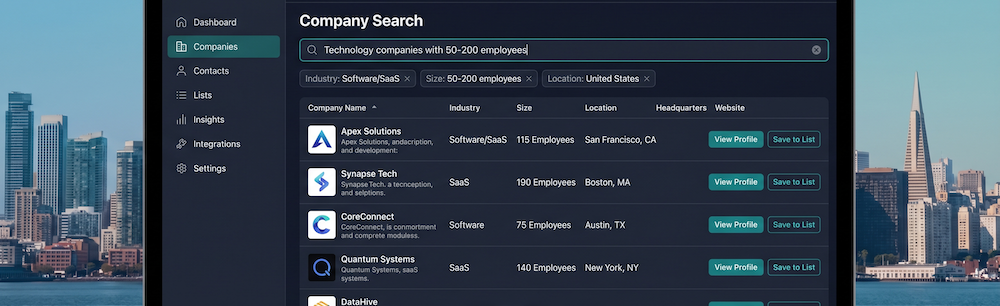
Rather than searching a fixed database, LocalSearch runs a bespoke, AI-orchestrated search pipeline across a range of sources, including sources that surface businesses with very thin online presences, or none at all beyond a social media page. The system accepts natural-language input: a procurement officer can describe what they're looking for in plain terms, and LocalSearch automatically extracts the relevant location parameters, search terms, and intent, then processes these through its pipeline.
The results bring together businesses from multiple sources, presented transparently: each result shows where it came from, so procurement teams can understand how and why a particular business surfaced. Results are filterable and reorderable, and the system is designed to surface businesses that conventional searches would miss, not to replicate what a Companies House or Google search would already return.
This is still new technology. LocalSearch is currently in beta, and we're learning from each deployment. One early outcome worth sharing: we've already helped one local authority customer identify a range of local businesses they had no prior knowledge of, several of which are now being included in future procurement and tendering activities. That's the kind of result that's difficult to achieve with any existing tool.
Deep Dive: From Discovery to Intelligence
Finding a business name and a vague description is only the starting point. Knowing whether to engage with them (whether they're credible, financially sound, actually operating in the right area) requires more.
LocalSearch is integrated with SimplyDo's broader Innovation Intelligence suite. Selecting a search result triggers an automatic deep dive: the system surfaces key insights about the business, including contact details, social and blog links, recent news, Companies House lookups, credit information and financial checks (available on demand), and director and shareholder data. SimplyDo also automatically generates a summary of the products and services the business offers, derived from all the available information, so procurement teams get a coherent picture of what the business actually does, rather than having to piece it together themselves.
Collaboration, Lists, and Outreach
Supplier discovery in local authorities isn't usually a solo exercise. Teams need to discuss what they've found, share judgements about which businesses are worth pursuing, and coordinate across procurement exercises that may span multiple people or departments.
LocalSearch is built for this. Teams can leave notes against individual businesses to discuss their potential, and add businesses to named lists representing a shortlist for a particular procurement activity, a pipeline of businesses to monitor, or any other grouping that makes sense for how the team works.
Those lists can then be used to send bulk communications directly to the identified businesses: invitations to workshops, requests to engage with a procurement process, or invitations to an open call or innovation challenge running on SimplyDo. The pipeline from discovery to engagement is contained within the same platform, rather than requiring data to be exported and managed elsewhere.
Designed for the SimplyDo Ecosystem
LocalSearch isn't a standalone product. It's been designed to fit into the broader SimplyDo platform, specifically, to help identify potential applicants for innovation clusters, programmes, and open calls.
A local authority using SimplyDo to run an innovation challenge for local suppliers can use LocalSearch to find businesses it didn't previously know existed, add them to a list, invite them to the programme, and then manage their application through SimplyDo's standard opportunity and assessment workflow. The discovery and the programme management sit in the same place, with a consistent record of how businesses were found, invited, and engaged.
The system is GDPR compliant and designed to scale with demand.
A Different Kind of Supplier Intelligence
Supply chain enrichment in local government has historically meant updating a database. LocalSearch is designed to do something more ambitious: to surface the businesses that have never made it onto any database, that exist in the gaps of formal supplier registers, and that represent real opportunities for local authorities to grow their supply base, support local businesses, and meet their procurement and economic development objectives more effectively.
We're still early in this work. But the early results suggest the gap we're trying to close is real, and worth closing properly.
If you work in local government procurement or supply chain development and want to see LocalSearch in action, we'd be very glad to show you.





.jpg)


